
Why the average matters
If you buy the same asset several times at different prices, your real entry is the quantity-weighted average of those purchases, not the simple average of the prices. A large purchase at a low price pulls the average down further than a small one.
Formula
Average price = (P₁Q₁ + P₂Q₂ + … + PₙQₙ) ÷ (Q₁ + Q₂ + … + Qₙ)Break-even price = (Σ PQ + Σ fees) ÷ Σ QWorked example
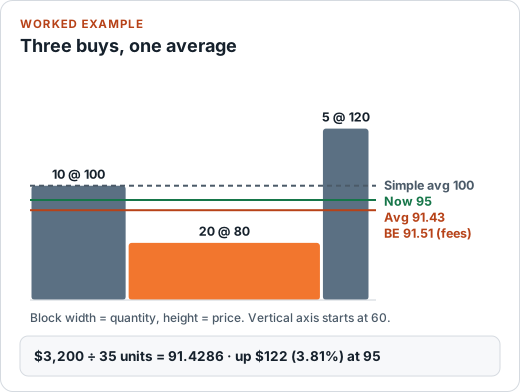
You buy 10 units at 100 (fee 1), 20 units at 80 (fee 2) and 5 units at 120 (no fee). The current price is 95.
- Total cost = 1,000 + 1,600 + 600 = 3,200 for 35 units
- Average price = 3,200 ÷ 35 = 91.4286 (the simple average of 100, 80 and 120 would be 100)
- Total fees = 3; break-even price = 3,203 ÷ 35 = 91.5143
- Unrealised result at 95 = 35 × 95 − 3,200 − 3 = +122.00, about 3.81% of the amount invested
Reading the result: averaging down
Suppose you buy 100 units at 50 and, after a fall, another 100 at 40, with no fees. You now hold 200 units at an average price of 45.00, a total cost of $9,000. If the market is trading at 42, the position is down 600 (6.67% of cost), even though the second purchase was made lower.
Averaging down lowers the price at which you break even, but it also doubles the amount you have at risk in the same idea. The average only improves your break-even; it does not improve the odds that the price recovers. Decide the total amount you are willing to lose on the idea before adding to it, and check that the combined position still fits your risk per trade with the trading risk % calculator.
How to use it
- Enter each purchase's price and quantity, and its fee if there was one.
- Use “Add purchase” for more rows; use Remove to delete one.
- Enter the current price to see unrealised profit or loss.
Assumptions and limitations
- Long positions only; sales and partial exits are not modelled here. See the Partial Close Calculator for scale-outs.
- Fees are the absolute amounts you enter, once per row. Selling fees are not included.
- Tax treatment of cost basis (for example FIFO or average cost rules) varies by country. This tool does not produce tax figures.
Common mistakes
- Averaging the prices without weighting by quantity.
- Treating a lower average as a reason to keep buying. A lower average does not change the fact that the asset is below your earlier entries.
- Leaving fees out when they are a meaningful share of a small purchase.
FAQ
Is this the same as dollar-cost averaging?
Dollar-cost averaging is a buying habit; this tool just calculates the weighted average price of whatever purchases you enter, however you made them.
Why is the break-even price higher than the average price?
Fees you paid have to be recovered before you are even. The break-even price spreads the total fees across all units: (total cost + total fees) ÷ total quantity.
Can I use it for short positions?
This version is built for buying and accumulating a long position. Selling short in stages uses the same weighted-average idea, but the profit sign is reversed, so the unrealised figure shown here would be wrong for a short.
What happens if I leave a fee blank?
A blank fee counts as zero for that row.