
Leverage and Margin: A Practical Guide
On this page
What leverage and margin mean
Leverage allows a trader to open a position larger than the cash they have deposited, by effectively borrowing the rest from a broker. Margin is the portion of the trader's own equity that must be set aside as collateral for that borrowed exposure. The two are directly linked: the higher the leverage, the smaller the margin required for a given position size. This applies whether you're using a forex leverage calculator for a currency pair or working out leverage on a crypto leverage calculator for a leveraged coin position.
The formulas
Leverage = Position Value ÷ Account EquityMargin Required = Position Value ÷ LeverageMaximum Position Value = Account Equity × Leverage
These three formulas describe the same relationship from different angles. Given any two of leverage, equity and position value, the third can always be derived.
Worked example
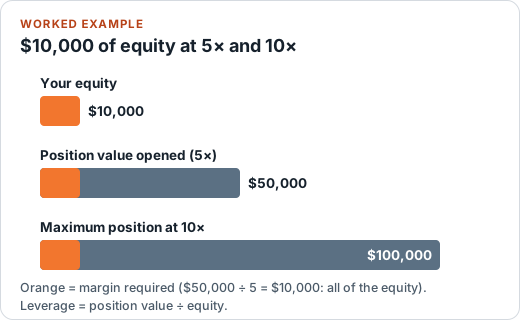
You have $10,000 in account equity and you open a position worth $50,000 in total.
- Leverage used = $50,000 ÷ $10,000 = 5x
- Margin required at 5x leverage = $50,000 ÷ 5 = $10,000 (all of your equity)
If your broker instead offers 10x leverage and you want to know your maximum position size: Maximum Position = $10,000 × 10 = $100,000. Using the full amount available is rarely advisable — see the risk section below.
Why leverage magnifies risk, not just position size
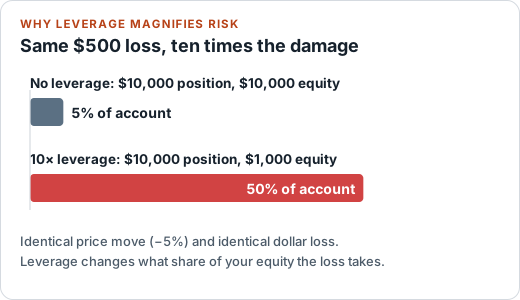
Leverage does not change the percentage move required in the underlying asset to reach a given dollar loss — it changes how much of your equity that dollar loss represents. A $500 loss on a $10,000 unleveraged position is a 5% account loss. The same $500 loss on a position opened with 10x leverage against $1,000 of equity is a 50% account loss, even though the dollar amount lost and the price move are identical.
This is why leverage is often described as a multiplier on both outcomes: it does not make a trade idea more or less likely to succeed, but it scales the equity impact of however the trade actually performs.
A margin call and liquidation are two different stages of the same problem, not the same event. A margin call is a broker's warning that your equity has fallen close to the required maintenance margin — it's a prompt to deposit more funds or reduce your position yourself. Liquidation is the broker forcibly closing some or all of your position once equity falls through a lower, stricter threshold, with or without a prior warning. Whether a margin call happens before liquidation, and how much buffer exists between the two, depends entirely on your specific broker's rules.
Margin at different leverage levels
For one fixed position of $10,000, the margin the broker holds falls as the leverage multiple rises:
| Leverage | Margin required | Margin as % of position |
|---|---|---|
| 2× | $5,000 | 50% |
| 5× | $2,000 | 20% |
| 10× | $1,000 | 10% |
| 20× | $500 | 5% |
| 50× | $200 | 2% |
Higher leverage does not change the size of the position or what each price move is worth; it only lowers the capital tied up. That frees money, and it also means a small adverse move consumes a larger share of the margin you posted. Whether a position is safe depends on the stop and the size, not on the leverage label. To see how leverage moves the price at which an isolated-margin position would be closed by the exchange, use the liquidation price calculator.
Watch for the difference between stated and effective leverage. A platform may allow 50×, but if you open a $10,000 position on $5,000 of equity your effective leverage is 2.0×, and that is the number that describes your exposure.
Common mistakes
- Using maximum available leverage by default. The leverage limit offered by a broker is a ceiling, not a target — most experienced traders use a small fraction of what is available.
- Confusing margin with risk. Margin is collateral, not a loss — but a highly leveraged position can lose its entire margin (and trigger a margin call or liquidation) from a relatively small adverse price move.
- Ignoring position sizing when leverage is available. Leverage changes how much exposure a given amount of equity can control — it does not remove the need to size positions according to a defined risk percentage, as covered in the Position Size guide.
Frequently asked questions
What is leverage in trading?
Leverage lets a trader control a position larger than their account equity by borrowing the difference from a broker. It multiplies both potential gains and potential losses relative to the equity actually deposited.
What is margin?
Margin is the amount of a trader's own equity that must be set aside to open and maintain a leveraged position. It is calculated as the position value divided by the leverage used.
Is high leverage dangerous?
High leverage increases how quickly losses can consume an account's equity, since a small adverse price move produces a much larger percentage loss on the equity used. Many experienced traders use only a fraction of the maximum leverage a broker offers.
Related guides and tools
- Run your own numbers in the leverage calculator, or browse all trading calculators.
- Read How to Calculate Position Size because leverage sets what you can open, not what you should risk.
- Read Risk/Reward Ratio Explained to weigh potential reward against the amplified risk.
- Read Risk Management in Trading to set limits on leverage and open risk.
- Read ROI in Trading to see how leverage changes return on your capital.
- See every topic in the guides library.
- Estimate where a leveraged position could be liquidated with the liquidation price calculator.
- See net profit after fees and funding in the futures P&L calculator.
About the author
SOFTYTOOLS Editorial Team writes and maintains the calculators and guides on this site, focusing on clear, formula-based explanations of trading and investing concepts rather than opinion or speculation.