
How to Calculate Position Size the Right Way
On this page
What position size actually means
Position size is simply how much of an asset you buy or sell in a single trade — expressed in shares, coins, contracts, or lots. It is one of the few variables in trading you control completely. You cannot control whether a trade wins or loses, but you can control exactly how much money is on the line when it does.
Two traders can take the identical entry, stop-loss and take-profit on the same asset and end up with completely different outcomes purely because they used different position sizes. Get the size wrong and even a strategy with a real statistical edge can produce account-damaging losses during a losing streak.
The position size formula
The calculator on this site uses a two-step, percentage-based formula that works the same way regardless of the instrument:
Risk Amount = Account Balance × Risk % ÷ 100Step 2 —
Position Size = Risk Amount ÷ |Entry Price − Stop-Loss Price|
The first step converts your risk tolerance — expressed as a percentage of your account — into a fixed dollar (or other currency) amount. The second step divides that dollar amount by the price distance between your entry and your stop-loss, giving you the number of units that will lose exactly that dollar amount if the stop-loss is hit.
Worked example
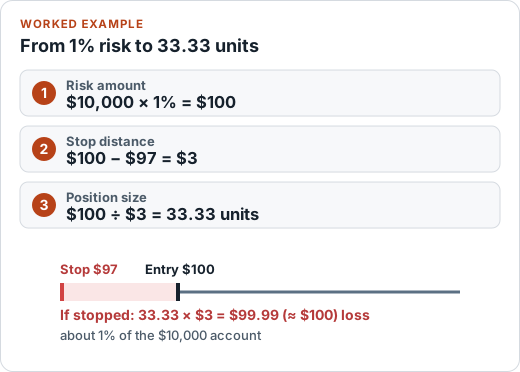
Say you have a $10,000 account and you never want to risk more than 1% on a single trade. You plan to buy an asset at $100 and place your stop-loss at $97.
- Risk Amount = $10,000 × 1% = $100
- Price distance = $100 − $97 = $3
- Position Size = $100 ÷ $3 = 33.33 units
If the price falls to $97 and your stop-loss triggers, you lose approximately $100 (33.33 × $3 = $99.99, because 33.33 is a rounded figure) — about 1% of your account, regardless of how far away the stop was placed in price terms. This is the core benefit of percentage-based sizing: the dollar risk stays constant even as your stop distance changes from trade to trade.
Applying it to forex, crypto and stocks
The formula above works in any market because it operates purely on price distance, not on market-specific units. A few practical notes for each market:
Forex position sizing
Forex is usually quoted in lots (a standard lot is typically 100,000 units of the base currency), so a forex position size calculator is really a forex lot size calculator by risk. Calculate your position size in units first using the formula above, then divide by the contract size — the Position Size Calculator does this automatically with the "units per lot" field.
Forex traders often think in pip value rather than raw units. A pip is typically the fourth decimal place of a currency pair's price (the second decimal for pairs quoted in yen), so the price distance in the position size formula above is just the number of pips multiplied by the pip size. Once you know your position size in units, pip value follows directly: for a standard lot (100,000 units) of a pair quoted against the US dollar, one pip is usually worth about $10; for a mini lot (10,000 units) it's about $1. Scaling the position size formula's output by the pip size this way lets you cross-check a units-based result against a broker platform that quotes risk in pips instead.
Crypto position sizing
A crypto position size calculator works the same way as a crypto risk calculator: crypto exchanges usually let you enter fractional coin amounts directly, so the units figure from the formula can typically be used as-is. Be mindful of any minimum order size or step size your exchange enforces.
Stock and CFD position sizing
For shares, the "units" from the formula are simply the number of shares. Many brokers only allow whole shares, so round down to avoid slightly exceeding your intended risk.
How the stop distance changes the size
The risk amount stays fixed, so the position shrinks as the stop moves further away. The table keeps a $10,000 account, 1% risk ($100) and an entry of 100.00, and varies only the stop.
| Stop price | Stop distance | Position (units) | Position value |
|---|---|---|---|
| 99.00 | 1.00 | 100.00 | $10,000.00 |
| 98.00 | 2.00 | 50.00 | $5,000.00 |
| 97.00 | 3.00 | 33.33 | $3,333.33 |
| 95.00 | 5.00 | 20.00 | $2,000.00 |
| 90.00 | 10.00 | 10.00 | $1,000.00 |
A stop ten times further away means a position one tenth the size, but the money at risk is identical in every row. This is why a trader who sizes by risk can hold a small position in a volatile market and a larger one in a quiet market with the same 1% risk. It also shows that position value is not the same as risk: the first row is a $10,000 position and the last is $1,000, yet both risk $100.
Forex lot size and contract size
For forex the calculator gives units and, if you enter the units per lot, lots. With a $10,000 account risking 1%, a EUR/USD entry of 1.0850 and a stop at 1.0820, the distance is 0.0030 and the position is 100.00 ÷ 0.0030 = 33,333.33 units. With a contract size of 100,000 that is 0.3333 lots.
Platforms normally accept lots in steps such as 0.01, so you would enter 0.33 lots. That risks 0.33 × 100,000 × 0.0030 = $99.00, a little under the $100 budget. Always round down, never up. The same arithmetic works for this pair only because the quote currency is the account currency; for other pairs convert the result with the pip value calculator.
Common mistakes
- Sizing by "gut feel" instead of the stop distance. A fixed number of shares or lots does not account for how far your stop actually is, so identical position sizes can carry very different risk from trade to trade.
- Ignoring fees and spread. The formula above measures price risk only — transaction costs add to your real-world loss and should be factored in separately for tight stops.
- Widening the stop to "fit" a desired position size. The stop-loss should be placed where the trade idea is invalidated, not adjusted to justify a bigger position.
- Recalculating rarely. As your account balance changes, the dollar value of a fixed risk percentage changes too — recalculate position size for every new trade.
Frequently asked questions
What is position size in trading?
Position size is the number of units, shares or lots you trade in a single position. It determines how much money moves for every tick the price moves, and therefore how much you gain or lose.
What is a safe position size?
There is no universal safe size — it depends on your stop-loss distance and how much of your account you are willing to risk. Many traders risk between 0.5% and 2% of their account per trade, then size the position so that if the stop-loss is hit, the loss equals that percentage.
Does position size affect risk if my stop-loss stays the same?
Yes. With a fixed stop-loss distance, a larger position size increases the dollar amount at risk, and a smaller position size decreases it, even though the stop-loss price itself has not changed.
Is position size the same as lot size?
Not quite. Position size is usually measured in raw units (shares, coins or base-currency units), while a lot is a fixed contract size — commonly 100,000 units for a standard forex lot. To convert, divide your position size in units by the lot size to get the equivalent number of lots.
Try the Position Size Calculator
Related guides and tools
- Run your own numbers in the position size calculator, or browse all trading calculators.
- Read Risk/Reward Ratio Explained to judge whether a trade's potential reward justifies its risk.
- Read Setting Stop Loss and Take Profit Levels to place exits from a risk amount once you know your size.
- Read Risk Management in Trading to see how position sizing fits into a complete risk plan, and Position Sizing vs Risk Management for the difference between the two.
- Read the Trading Risk Percentage guide to choose the percentage that feeds this formula.
- Read Leverage and Margin to see how leverage relates to the size of position you can open.
- See every topic in the guides library.
- Turn a position size into a full plan with fees and a safety check in the Trade Planner.
- Convert pips to money with the pip value calculator.
About the author
SOFTYTOOLS Editorial Team writes and maintains the calculators and guides on this site, focusing on clear, formula-based explanations of trading and investing concepts rather than opinion or speculation.